
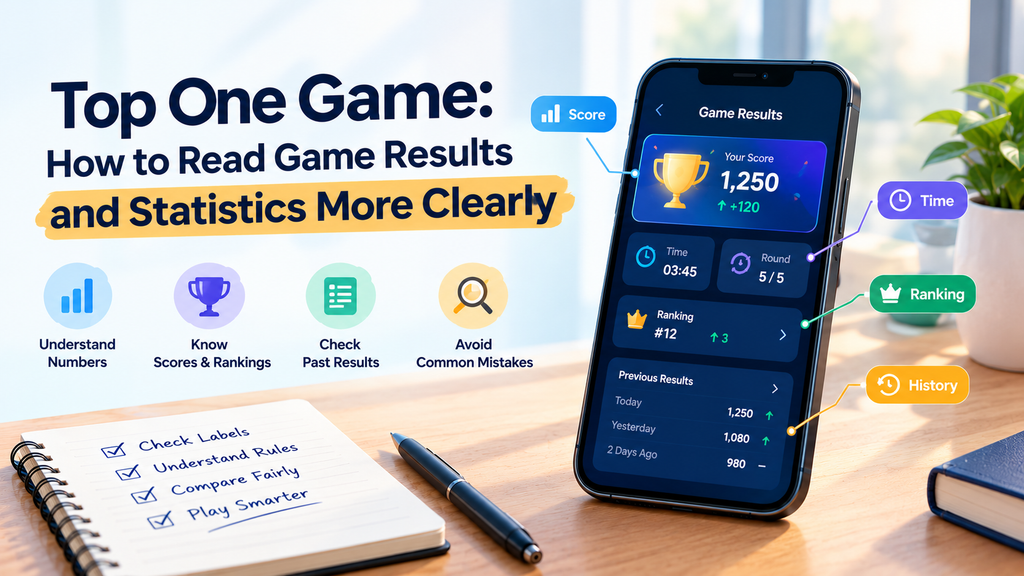
Numbers on a game screen can tell you more than whether you won or lost. Depending on the game, results may include scores, round details, rankings, previous outcomes, or other statistics. Knowing how to read this information can help you understand what happened instead of making guesses.
When using the top one game platform, it is useful to separate facts from assumptions. A number may describe one round, a past result, or a particular activity. It does not always tell the whole story.
This guide explains how to read game results carefully, understand common statistics, and avoid mistakes when interpreting information displayed on your screen.
Start by Identifying What Each Number Means
A game screen may display several numbers at the same time. Some may represent scores, while others could refer to time, rankings, totals, or individual rounds.
Before drawing a conclusion, identify what each number represents.
Read the Label Beside the Number
Labels provide important context. A number displayed beside the word “score” means something different from one shown beside “time” or “round.”
For example, a score of 50 does not automatically mean you performed better than someone with a score of 40. The scoring system may work differently depending on the game.
When viewing the top one game, read the labels and available instructions before comparing numbers.
Check the Time Period
Some statistics describe a single round, while others cover several rounds or a longer period.
A result from one round should not be treated as a complete record of your overall activity. Always check whether the information relates to the current game, previous results, or a larger summary.
This small step can prevent misunderstandings.
Understand the Difference Between Scores and Rankings
Scores and rankings are related in some games, but they do not mean the same thing.
A score represents a value earned or recorded under a game’s rules. A ranking shows a position in relation to other participants or results.
Learn How the Scoring System Works
Different games use different scoring methods. Some award points for specific actions, while others use time, accuracy, completed tasks, or other measures.
Read the instructions to understand how a score is calculated. Without that information, a high number may be difficult to interpret.
Do not assume that every game uses the same scoring method simply because the screens look similar.
Treat Rankings as Context, Not Proof
A ranking can show where a result stands within a particular group or period. However, it may change when new results appear.
If a game displays a leaderboard, check what it measures and when it was last updated, if that information is available.
A ranking is one piece of information. It does not necessarily explain every detail of a player’s performance.
Read Previous Results Without Making Predictions
Some games provide a record of earlier rounds or activities. These records can help you review what happened, but they should not be confused with a reliable prediction of what will happen next.
Understand What a History Screen Shows
A history screen may list earlier outcomes in chronological order. Depending on the game, it could also show dates, scores, or other details.
Use the available labels to understand what is being recorded.
If you are using topone game features that display past results, remember that historical information describes previous events. It does not automatically establish a pattern that will continue.
Avoid Guessing From Short Sequences
Seeing the same result several times can make it feel as though a different result must come next. That conclusion is not always justified.
The meaning of previous results depends on the game’s rules and how its outcomes are determined.
Do not treat a short sequence as proof of a future result. Read the game’s instructions and avoid making decisions based on unsupported predictions.
Learn to Recognize Incomplete Information
A result may not explain everything that happened during a game. Some screens show only a summary, leaving additional details in another section.
Look for Missing Context
Before interpreting a result, ask yourself:
- Does this number relate to one round or several?
- Is the date or time shown?
- Are the rules for calculating it available?
- Is the information complete?
- Has the screen been refreshed since the result appeared?
These questions are useful when a result seems surprising or different from what you expected.
Do Not Rely on Cropped Screenshots
A screenshot shared online may leave out important labels, dates, or conditions. It may also show an older version of a screen.
Treat screenshots as examples rather than complete proof. If the information matters, check it directly in the game or through a reliable source.
Compare Results Fairly
Comparisons can be useful when you understand what is being compared. They become misleading when the figures come from different conditions.
Use the Same Measurement
Imagine comparing two results from different games. One uses points, while the other records completed tasks. Comparing their raw numbers would not tell you much.
A useful comparison requires the same type of measurement and enough context to interpret it.
For top one game download guides or other gaming resources, look for explanations of the relevant scoring rules rather than relying on numbers alone.
Remember That Conditions Can Change
Results may depend on the game mode, difficulty, rules, or other factors. If those conditions differ, the results may not be directly comparable.
Check the available details before deciding that one result is better than another.
Keep a Clear Record of Important Results
If you want to remember what you have learned, a simple record can be helpful. You do not need to save every screen or write a detailed report.
Record Only Useful Details
A short note might include:
- The date of the result
- The game mode, if applicable
- What the displayed score represents
- A detail you learned from the round
- A question that still needs clarification
Keep the notes factual. Avoid recording guesses as though they were confirmed information.
Protect Your Private Information
Before saving or sharing a screenshot, check whether it contains your username, account details, personal messages, or other information you would prefer to keep private.
Crop or hide sensitive details when appropriate. Never include passwords or verification codes in gaming notes.
Check Whether the Information Is Current
Game screens and features can change after an update. An older guide may describe a layout or statistic that no longer appears in the same place.
Confirm Details After Changes
If a screen looks different, read the updated instructions before relying on an older explanation.
When checking information related to a top one apk, make sure the guide applies to the version you are using. A screenshot from another release may not match your current interface.
Avoid downloading a different app file just because an online guide shows a screen you cannot find. Confirm the source and version details first.
Common Mistakes When Reading Game Statistics
A few habits can make results harder to understand.
- Ignoring labels: A number without context can be misleading.
- Mixing different measurements: Scores, time, and rankings are not interchangeable.
- Assuming past results predict future ones: Historical records do not guarantee what comes next.
- Comparing different conditions: Results may use different rules or game modes.
- Trusting every screenshot: Shared images can be incomplete or outdated.
- Treating guesses as facts: A possible explanation is not the same as a confirmed one.
Taking a moment to check these details can make game information much easier to interpret.
Final Thoughts
Reading game results clearly starts with understanding what the numbers represent. Check the labels, learn the scoring rules, pay attention to dates, and compare results only when the conditions make sense.
The top one game experience can be easier to understand when you use statistics as information rather than treating every number as a prediction. If something looks confusing, return to the game’s instructions and verify the details before drawing a conclusion.
A careful reading of results helps you understand what happened, recognize missing context, and make better-informed decisions during your gaming experience.